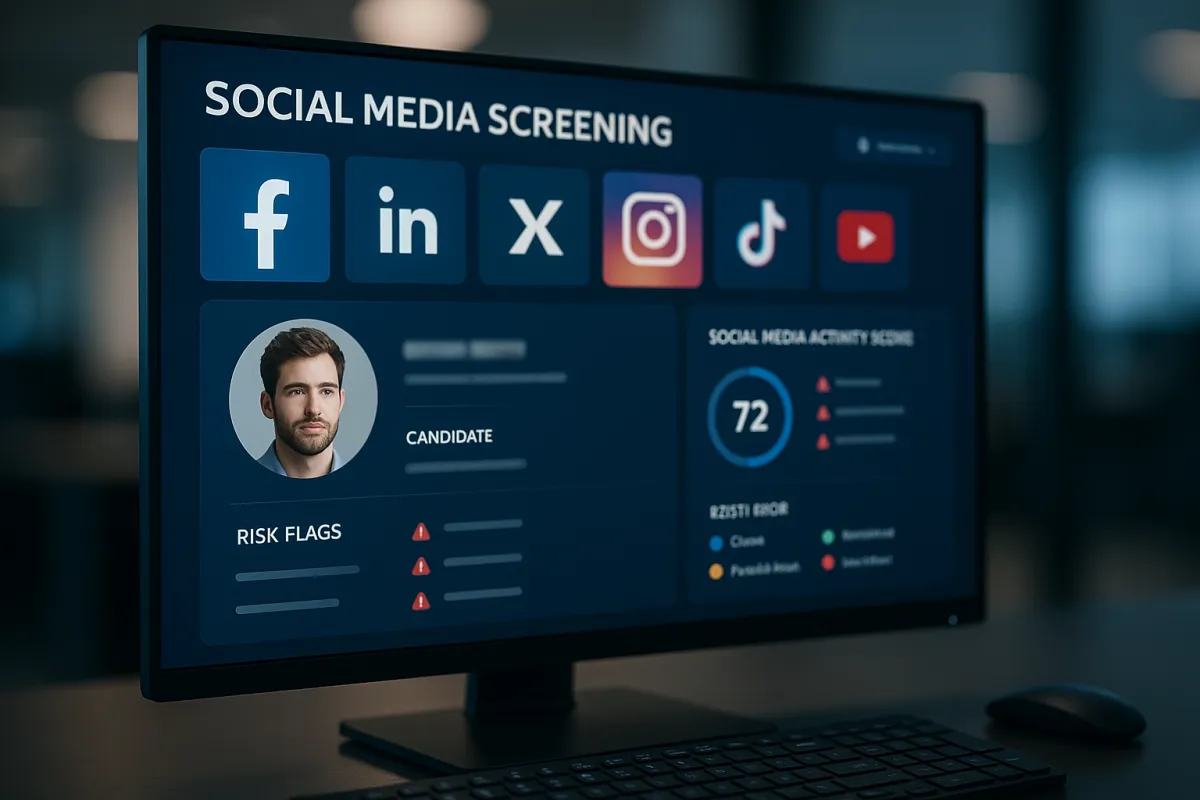
Social Media Screening: The Risks Most Employers Are Taking
Here is a question I want you to sit with for a moment. Your HR team has just run a candidate through a social media screening platform before the second interview. It has surfaced accounts they did not know existed. Posts from two years ago that made everyone in the room deeply uncomfortable. The candidate is not shortlisted. Nobody writes anything down. Nobody tells them why. Is your organisation exposed?
The answer is almost certainly yes. And the uncomfortable reality is that this is happening in organisations across the UK every single week.
Social media screening platforms have become significantly more sophisticated in the last few years. They do not just search the obvious profiles a candidate has put on their CV. They surface connected accounts, historical posts, usernames linked to an email address, content the candidate may have assumed was buried or forgotten. The picture they build can be genuinely revealing. That is precisely what makes them useful. And precisely what makes them dangerous if the process around them is not right.
This is not an article arguing that social media screening is wrong. Done correctly, with a structured process, clear documentation and a lawful basis, it can be a valuable and proportionate part of pre-employment due diligence. But the way most organisations currently approach it is not correct, and the legal and financial consequences of getting it wrong are real.
Why Organisations Use These Platforms at All
The case for structured social media screening is legitimate. These platforms can surface things that no CV, reference or formal check will ever reveal. Publicly expressed violent or threatening behaviour. Discriminatory views that would make someone wholly unsuitable for a role involving vulnerable people or regulated conduct. Evidence of dishonesty about professional background or qualifications. Content that directly contradicts what a candidate has presented in interview.
In certain sectors, the argument is even stronger. A candidate applying for a safeguarding role, a security industry position, an FCA regulated role, or a CQC registered care environment is held to a higher standard of conduct. If their public social media activity reveals a pattern of behaviour that is directly relevant to the nature of the role, there is a proportionate case for taking it into account as part of a formal, documented process.
The word that matters in that sentence is formal. The problem is almost never the decision to screen. The problem is the absence of any structure around it.
What the Platform Surfaces That You Were Never Supposed to See
This is where the legal exposure sits, and it is significant.
A social media screening platform that surfaces hidden accounts, connected profiles and historical content will almost inevitably return information that falls within the protected characteristics under the Equality Act 2010. Age. Ethnicity. Religion. Pregnancy. Sexual orientation. Political beliefs. Disability. Gender reassignment. None of these are relevant to the vast majority of roles. All of them are visible in a comprehensive social media search. And once your decision makers have seen them, they cannot unsee them.
Once you are aware of these characteristics, you cannot un-see them, so it becomes extremely difficult to argue that they have not been taken into account during the recruitment process. First Advantage If a candidate is subsequently rejected and later discovers that a platform search was run, the basis for a discrimination claim is already in place before a single word of a tribunal bundle has been written.
Poorly controlled screening can lead to discrimination claims, ICO complaints, regulatory scrutiny and reputational damage. In tribunal proceedings, informal screening is often difficult to justify because it lacks transparency, consistency and evidence of lawful decision-making. DavidsonMorris
The Employment Rights Act 2025 has extended the tribunal window for most claims from three to six months. The cap on compensation for unfair dismissal is being removed entirely. The financial exposure from a successful discrimination claim is heading in one direction only.
The GDPR Layer That Makes This Even More Complex
Social media screening is not just an equality issue. It sits directly on top of a data protection obligation, and the two risks compound each other.
UK GDPR requires that any processing of personal data has a lawful basis, that candidates are informed of how their data will be used, and that any data collected is proportionate to the purpose for which it is processed. When a social media screening platform is run against a candidate's profile without those foundations in place, every one of those requirements is being breached simultaneously.
Employers must inform candidates that social media screening forms part of the recruitment process and explain what platforms may be reviewed, the purpose of the screening, the lawful basis relied upon, how the information will be used and how long any data will be retained. This information should be provided at the outset of the recruitment process, typically in privacy notices or recruitment documentation. DavidsonMorris
How many organisations using social media screening platforms have that disclosure in their candidate privacy notice right now? In my experience from two decades of operational vetting work, very few. Most have never considered it.
The Data Use and Access Act 2025 is being brought into effect through commencement regulations throughout 2026. It sharpens obligations around automated decision making, legitimate interests as a lawful basis for processing, and the handling of subject access requests. The regulatory environment for data protection in screening is tightening, not easing off.
Where the Process Breaks Down Most Often
In twenty years of operational vetting work across security, healthcare, financial services and government, I have seen social media screening go wrong in the same ways repeatedly.
The platform search is run without HR being in the loop. The output is reviewed by the hiring manager alone. Nothing is documented. The candidate is rejected but the documented reason bears no resemblance to what actually influenced the decision. Nobody can reconstruct what was surfaced, when it was reviewed, or what weight it was given.
That is not a process. That is a liability sitting undetected inside your recruitment workflow.
The second failure is inconsistency. Some candidates for the same role are screened using the platform. Others are not. Some are screened at shortlisting stage, others at offer stage. When two candidates compare notes, or when an unsuccessful candidate submits a subject access request, the inconsistency becomes a problem in its own right.
The third failure is the most structurally damaging. An organisation may have a perfectly sound right to work process, a solid DBS framework and a reasonable reference checking procedure. But if a social media platform search is running alongside all of that without proper governance, the informal activity contaminates the formal process. It undermines the defensibility of every decision made in that recruitment round.
You can read more about how informal processes affect your overall accountability in our post on outsourcing screening and employer responsibility.
How to Do It Correctly
A compliant approach to social media screening using a dedicated platform is achievable. It requires the same structured, documented discipline as every other element of your pre-employment process.
Decide at policy level whether social media screening is necessary, which roles it applies to, and on what basis. Write that decision down and review it. Disclose it properly. Your candidate privacy notice must reference the fact that a social media screening platform may be used, which categories of information may be reviewed, for what purpose and under what lawful basis. Make it consistent. Every candidate for the same role is screened in the same way, at the same stage, and the output is reviewed by HR, not the hiring manager. Where the platform surfaces something that influences a decision, the candidate is given the opportunity to respond before that decision is finalised. Everything is documented, proportionate and retained in line with your data retention policy.
This is not complicated. It is simply applying the same compliance discipline you should already be bringing to every other part of your screening process.
The Question Worth Asking Today
If one of your rejected candidates from the last six months submitted a subject access request tomorrow, and your team had to reconstruct exactly what platform was used, at what stage, what it returned, who reviewed it and how it influenced the outcome, could they do it?
If the honest answer is no, then your social media screening activity, however well intentioned and however well the platform itself performs, is a liability waiting to surface at the worst possible moment.
You can read more about building a fully defensible screening process in our post on what a compliant employment history verification process looks like in 2026.
At Vetting Hub, we work with HR Directors, Compliance Managers and Business Owners to build screening processes that are thorough, proportionate, legally defensible and consistent across every stage of recruitment. Our subscribers have access to practical frameworks, compliance tools and direct expert guidance to make sure their processes hold up when it counts. That includes the parts of the process most organisations have never thought to formalise, and social media screening sits right at the top of that list.
If you want to know whether your current approach would survive scrutiny, we are here to help.