Basic, Standard and Enhanced DBS Checks: Which One Do You Actually Need?
The question most employers are getting wrong
If you ask ten HR managers which level of DBS check they run on new starters, at least three of them will tell you something that is not legally permissible.
Not because they are careless. Because the rules around DBS checks are genuinely confusing, because the Disclosure and Barring Service website is not exactly written for busy people, and because somewhere along the way someone in the organisation decided that a higher level of check was always better. It is not. In many cases, requesting a standard or enhanced DBS check where there is no legal entitlement to do so is not a minor administrative error. It is unlawful.
This post covers what each level of DBS check actually discloses, which roles are eligible for which level, what the law says about entitlement, and what has changed in 2026 that every employer needs to know. If you have not reviewed your DBS decision-making framework in the last twelve months, this is the post you need to read before your next hire.
What the DBS actually does
The Disclosure and Barring Service is an executive non-departmental public body sponsored by the Home Office. It processes criminal record checks, maintains the children's barred list and the adults' barred list, and makes barring decisions on individuals who work, or seek to work, in regulated activity with children or vulnerable adults.
A DBS check is a disclosure of criminal record information held by the Police National Computer, and in some cases additional intelligence held by local police forces. The level of information disclosed depends entirely on which type of check has been applied for — and which type of check can legally be applied for depends on the nature of the role.
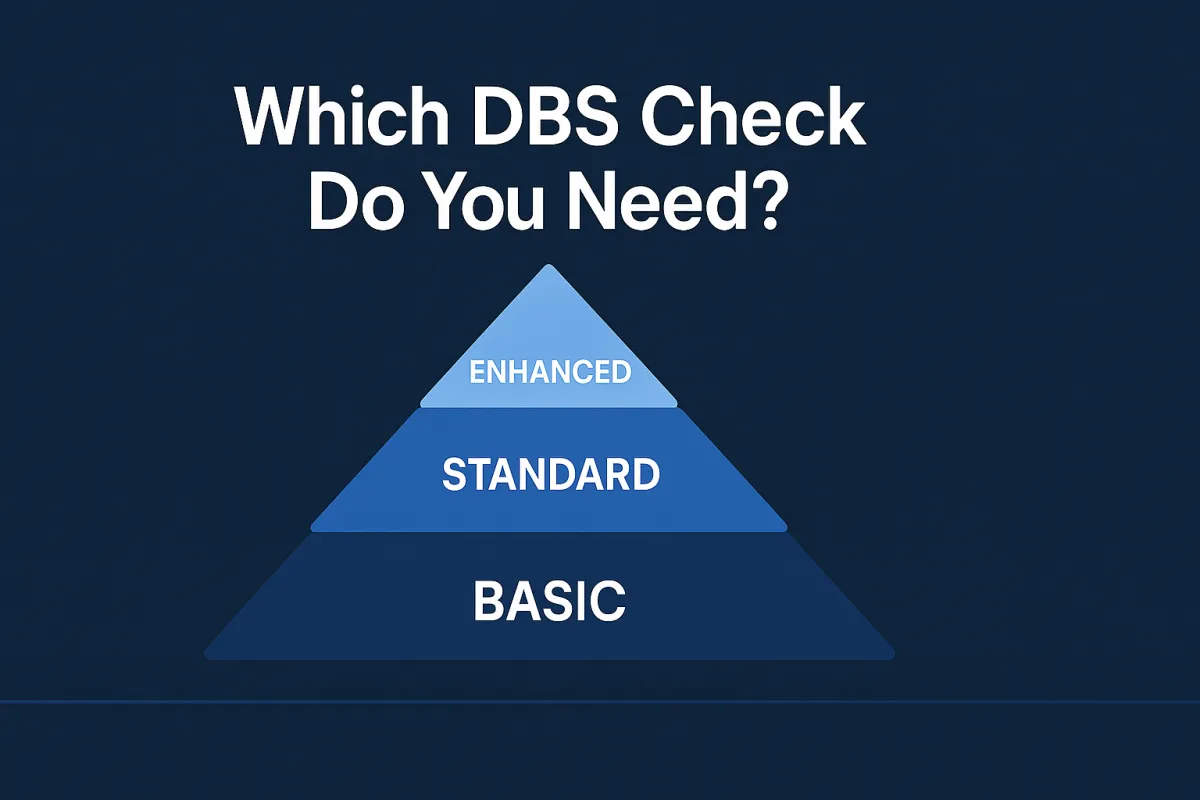
There are three levels: basic, standard and enhanced. They are not interchangeable. They do not exist on a sliding scale where more is simply better. Each one has a defined purpose, a defined eligibility threshold, and a defined legal basis.
Basic DBS checks
A basic DBS check discloses unspent convictions and conditional cautions only. Nothing else. If a conviction is spent under the Rehabilitation of Offenders Act 1974, it will not appear on a basic check — and that is by design, not by accident. Parliament made a deliberate decision that people who have completed their sentences and stayed out of trouble should not be permanently defined by their criminal record for most purposes.
Who can apply for a basic check?
Any individual can apply for a basic check on themselves through the DBS. Any employer can request one — there is no eligibility requirement. Basic checks are the default level for roles that are not in regulated activity and have no specific statutory requirement for a higher check.
When is a basic check appropriate?
For the majority of roles in the private sector, a basic check is the only check you are legally entitled to request. Retail, hospitality, office-based roles, customer service, most managerial positions, most professional services roles — none of these carry an entitlement to a standard or enhanced check. If you are running standard or enhanced checks on these roles, you are outside your legal entitlement and you are processing criminal record information you have no right to see.
What a basic check will not tell you
It will not tell you about spent convictions, even serious ones. It will not tell you about cautions that are not conditional cautions. It will not tell you whether someone is on a barred list. For roles where that information is genuinely relevant to safeguarding, a basic check is insufficient and a higher level check is both appropriate and legally required.
Standard DBS checks
A standard DBS check discloses both spent and unspent convictions, cautions, reprimands and warnings held on the Police National Computer. It does not include local police intelligence or barred list checks.
Who can apply for a standard check?
This is where entitlement begins to matter. Standard checks are available only for roles that are listed in the Rehabilitation of Offenders Act 1974 (Exceptions) Order 1975. The Exceptions Order sets out specific professions and roles where the spent conviction filtering rules are disapplied — in other words, where society has decided that the full picture of a person's criminal record is legitimately relevant to a risk assessment.
The list includes roles such as solicitors, accountants, registered nurses, teachers, financial services professionals regulated by the FCA, certain positions in the justice system and positions that involve working with children or vulnerable adults in some non-regulated contexts.
What it does not include
Most private sector roles. Most managerial or supervisory roles. Any position where the eligibility test has not been checked against the Exceptions Order. If a role is not listed in the Exceptions Order, you cannot run a standard check on it, even if you think it would be a good idea.
Requesting a standard check for an ineligible role is a breach of the Police Act 1997. The information you receive cannot be lawfully used in a hiring decision. And the individual whose record you have accessed without entitlement has a legitimate grievance.
Enhanced DBS checks
An enhanced DBS check discloses everything on a standard check, plus any additional information held by local police forces that a chief officer reasonably believes to be relevant and ought to be disclosed. It can also include a check against one or both of the DBS barred lists — the children's barred list and the adults' barred list.
The barred list check is not automatic. It must be specifically requested and is only available where the role involves regulated activity with children or with adults.
Who can apply for an enhanced check?
Enhanced checks are available for roles that meet the higher eligibility threshold — those listed in both the Exceptions Order and Schedule 3 of the Safeguarding Vulnerable Groups Act 2006. In practice, this means roles in regulated activity: teaching, social work, healthcare, roles involving personal care, supervised activity with children, certain positions in the justice system.
The eligibility threshold for an enhanced check is higher than for a standard check. If a role does not involve regulated activity or meet the Schedule 3 criteria, an enhanced check is not available. This is a legal boundary, not a policy preference.
The local intelligence disclosure
This is the element of the enhanced check that most employers do not fully understand. Local police can disclose information that has not resulted in a conviction — intelligence, allegations, soft information. Whether to disclose it is a decision made by the relevant chief officer on a case-by-case basis. It is not subject to the same filtering rules as conviction information. That means an enhanced check can surface information that is contested, unproven or historic. Handling that disclosure correctly — assessing it fairly, recording the decision, giving the individual an opportunity to respond — is a compliance requirement in itself.
What changed in January 2026
From 21 January 2026, self-employed workers and personal employees can now apply for enhanced DBS checks directly through an umbrella body, where the role meets the eligibility criteria for an enhanced check.
Previously, self-employed individuals had no route to an enhanced check. If an organisation engaged a self-employed contractor in a role that would ordinarily require an enhanced check — a private tutor, an independent carer, a freelance support worker — the only DBS check available was a basic check. That created a structural gap in safeguarding frameworks that many organisations managed around, often unsatisfactorily.
That gap has now closed for eligible roles. If a self-employed individual is undertaking regulated activity — and the role meets the eligibility threshold — they can apply for an enhanced check through an approved umbrella body. For organisations using personal employees, independent carers, private tutors and self-employed practitioners in regulated roles, the compliance picture has materially changed.
If you have not reviewed your screening approach for self-employed and contracted workers since January 2026, you need to do that now.
The pharmacy deadline that has just passed
From March 2026, all pharmacy professionals are required to hold a valid enhanced DBS check as a condition of the Pharmacy Quality Scheme. This is not a recommendation. It is a scheme requirement tied to pharmacy quality payments.
If your organisation employs pharmacy professionals — or if you are a pharmacy operator responsible for compliance — and you have not yet completed enhanced DBS checks for all relevant staff, you are operating outside scheme requirements. The time to address this is immediately, not at the next review cycle.
The mistakes employers make most often
Running the wrong level of check for the role. This goes in both directions. Some employers run basic checks on roles that require enhanced checks, leaving a genuine safeguarding gap. Others run enhanced checks on roles with no eligibility, creating legal exposure. Neither is acceptable.
Assuming higher is always better. It is not. Requesting an enhanced check on an administrative role because someone thought it was more thorough is not diligent — it is unlawful. You have no entitlement to that information and you cannot lawfully use it.
Not rechecking when roles change. An employee who moves from an administrative role into a role involving regulated activity needs a fresh DBS check at the appropriate level. A basic check from three years ago does not cover a new role in regulated activity.
Failing to handle disclosures correctly. Receiving a disclosure is not the end of the process — it is the beginning of a risk assessment. The decision about whether a disclosed conviction, caution or piece of local intelligence is relevant to the role, proportionate to the risk, and sufficient grounds to withdraw an offer is a judgement call that needs to be documented. It cannot be a blanket policy. The Rehabilitation of Offenders Act, the Equality Act 2010 and the ICO guidance on criminal record data all place obligations on how that judgement is made and recorded.
Not having a DBS policy in place. If you cannot produce a written policy that sets out how you decide which level of check applies to which roles, how disclosures are assessed, who makes the decision, and how records are retained and deleted, you are not compliant — regardless of whether the checks themselves were run correctly.
How to get this right
Start with the role, not the check. For every role in your organisation, ask three questions:
- Is this role listed in the Exceptions Order? If not, basic check only.
- If yes — does it meet the Schedule 3 threshold for an enhanced check? If not, standard check.
- If yes to both — does it involve regulated activity with children, adults, or both? That determines whether a barred list check is required alongside the enhanced check.
Document that assessment. If you are ever challenged on your DBS decision-making — by a candidate, by the ICO, by a regulator — your written assessment of why a particular level of check was appropriate for a particular role is your evidence. The absence of that documentation is the compliance gap.
If you have self-employed or contracted workers in roles that may now qualify for an enhanced check under the January 2026 change, review those arrangements now. The fact that the previous route was unavailable does not mean the current arrangement is appropriate indefinitely.
And when a disclosure comes back — even if there is nothing on it — record that you received it, when, and that you made a risk-based decision. If something is disclosed, record the disclosure, your assessment, who was involved in the decision, and the outcome. Retention of that record should follow your data protection policy: keep it only as long as necessary, then delete it.
This is not bureaucracy for its own sake. It is the difference between a defensible screening process and one that collapses under scrutiny.
Resources on the Vetting Hub platform
Courses
If you are responsible for DBS decisions in your organisation and you are not confident that your current process is legally compliant, these two courses are the place to start:
- DBS Checks Done Right: Ask, Assess and Record Confidently — covers eligibility, the application process, handling disclosures and building a compliant DBS framework from scratch.
- Defensible Screening Decisions: How to Assess Risk, Record Judgements and Survive an Audit — for compliance leads and HR professionals who need to demonstrate that their screening decisions can withstand regulatory scrutiny.
Toolkits
- DBS Employer Decision Framework — a structured tool for mapping roles against eligibility criteria and documenting the assessment.
- DBS Disclosure Assessment and Recording Template — for handling and recording disclosures in line with ICO guidance and the Rehabilitation of Offenders Act.
- New Starter Screening Checklist — ensures every new hire is screened at the correct level with nothing missed.
Further reading on the Vetting Hub blog
If you found this post useful, these are worth reading alongside it:
- Employment History Verification: A Compliant Process for 2026 — because DBS checks tell you about criminal record history, not employment history. Both need to be verified, and most employers have gaps in at least one.
- Civil Penalties for Illegal Working: The Myths Employers Still Believe — the same principle applies: believing you are compliant is not the same as being compliant.
- Manual vs Digital Identity Checks in Employment Screening — before you run any DBS check, you need to verify the individual's identity. This post covers how to do that correctly.
The bottom line
DBS checks are not a box-ticking exercise and the level of check is not a preference — it is a legal determination. Requesting the wrong level in either direction creates exposure: safeguarding exposure if you under-check, legal exposure if you over-check.
The January 2026 change for self-employed workers and the March 2026 pharmacy deadline are both live issues right now. If either of those applies to your organisation and you have not acted, the time is not later.
If you are not certain that your current DBS framework is correct — which roles are eligible for which checks, how disclosures are handled, how decisions are documented — the courses and toolkits on the Vetting Hub platform are the fastest way to fix that.
Vetting Hub provides training, consultancy and toolkits for employers who need their screening processes to be legally defensible. If you have a specific question about DBS eligibility or your current screening framework, get in touch.