Fake Certificates. Fake Identities. Real Jobs. AI Fraud in Pre-Employment Screening Is Already Happening. And Most UK Employers Are Not Catching It.
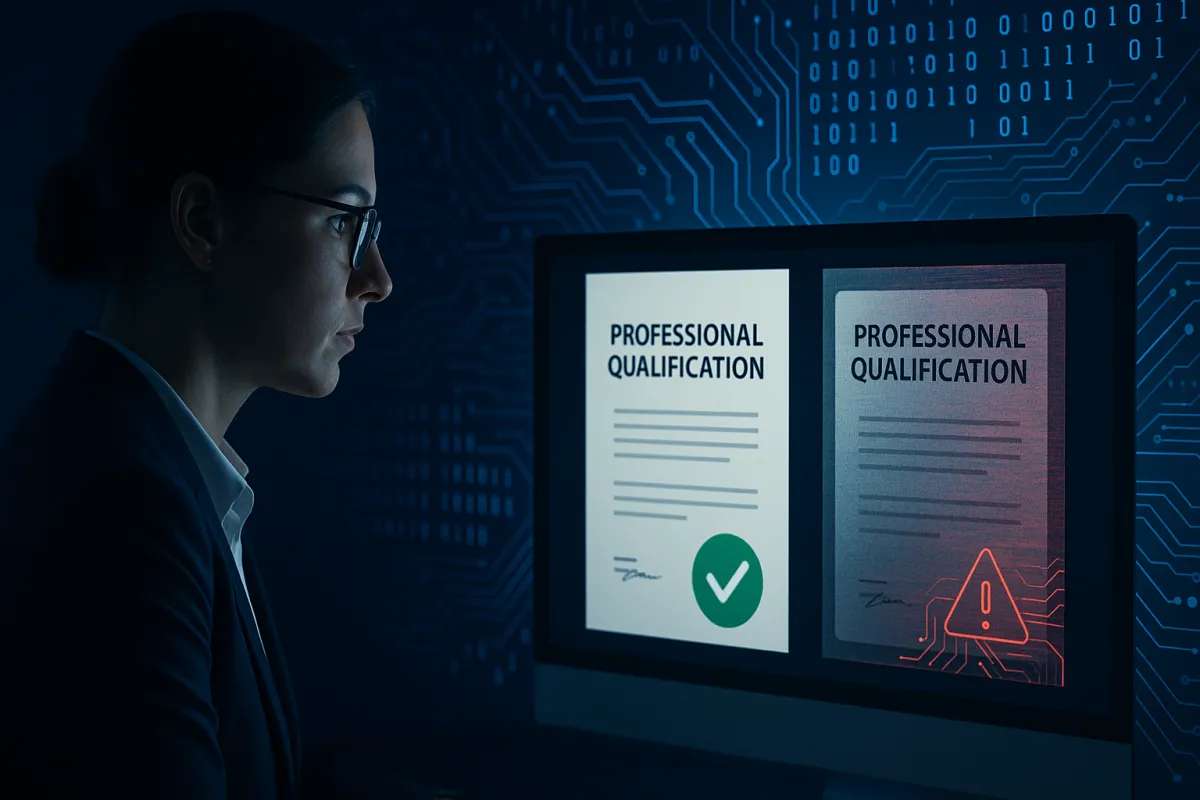
The certificate on screen looks exactly right. The qualification matches the role. The document passes visual inspection.
And none of it is real.
AI-generated fraudulent credentials are arriving in UK recruitment pipelines right now. A 2025 survey of 874 HR professionals found that 72% of recruiters encountered AI-generated or manipulated application documents during the hiring process. Of those forged submissions, 39% contained fake diplomas or certificates. This is not a future risk. It is happening in UK organisations today, and the standard pre-employment screening process was not designed to catch it.
The Threat Has Changed. Most Screening Processes Have Not.
For years, document fraud in pre-employment screening meant someone had altered a date, changed a name on a payslip or exaggerated a job title. Detectable with care. Catchable by a trained eye.
That is no longer what employers are facing.
Generative AI tools can now produce forged qualification certificates, degree transcripts, professional licences and employment letters that are visually indistinguishable from the originals. The logos are correct. The formatting is accurate. The fonts and seals match. There is no obvious evidence of tampering because nothing has been tampered with. The document was simply generated from scratch.
According to the 2026 State of Document Fraud Report published by Inscribe in January 2026, the monthly volume of AI-generated document fraud increased nearly fivefold between April and December 2025. In that same period, approximately 6% of all documents processed were flagged as fraudulent. Roughly one in sixteen.
That figure deserves to land. If your organisation processes a reasonable volume of new starters each year, the statistical likelihood that fraudulent documents have already passed through your process is not trivial.
The Documents Most at Risk
Not every document type carries equal risk. Based on current fraud patterns, these are the categories that demand heightened scrutiny.
Qualification certificates and degree transcripts. These are among the most commonly forged items in pre-employment fraud. AI tools can replicate institutional branding, authorisation stamps and certificate formats with minimal technical knowledge. The fraud is now accessible to people who, a few years ago, would not have had the means to attempt it.
Professional licences and sector-specific certifications. In regulated industries including healthcare, finance, security, care and education, professional certifications carry significant weight and directly affect legal compliance. A forged SIA licence, a fake First Aid certificate or a fabricated care qualification is not simply dishonest. It places people at risk and exposes the organisation to regulatory consequences that reach well beyond the hiring decision.
Employment history letters and references. AI can generate convincing letters of reference on plausible headed notepaper, complete with contact details that belong to non-existent companies or untraceable numbers. Our post on CV fraud and employment history verification covers how to use HMRC PAYE records as a more reliable route to confirming genuine employment history.
Identity documents. AI-generated passport and identity document fraud is no longer restricted to sophisticated criminal networks. For a fuller picture of how deepfake identity fraud is developing in live hiring processes, our post on AI deepfake fraud and employment screening in 2026 sets out exactly what employers are dealing with.
Why Standard Screening Is Failing
Most pre-employment screening processes rely on visual inspection of documents submitted digitally, cross-referenced against what the candidate has stated in their application.
That approach has two fundamental problems in the current environment.
First, visual inspection cannot reliably detect AI-generated forgeries. The errors that previously made fake documents catchable: inconsistent fonts, pixelation around edited areas, incorrect logos. These are being eliminated by generation tools that create documents from scratch. A document that was never real carries no signs of having been altered.
Second, the process rarely closes the loop on verification. Seeing a certificate does not confirm it exists. Calling a reference number provided by the candidate does not confirm the employer exists. Checking that a qualification name looks plausible does not confirm it was ever awarded.
Pindrop research cited in a January 2026 People Management report found that 62% of hiring professionals admit candidates are now better at using AI to deceive than recruiters are at detecting it. That reflects not a failure of effort but a gap in training and process that most organisations have not yet addressed.
Red Flags to Watch For
No single indicator proves fraud. But the following patterns, particularly in combination, should prompt further scrutiny before any hiring decision is made.
- Qualification certificates with no verifiable issuing institution or registration number
- Professional certifications that cannot be confirmed through the awarding body's public register
- Employment history letters with generic branding, missing company registration details or contact information that cannot be independently verified
- References that respond only to the contact details provided by the candidate themselves
- Documents submitted only as low-resolution scans or photographs that limit closer examination
What Employers Need to Do
The response to this threat is practical and achievable. It does not require large budgets or specialist technology in every case. It requires process.
Verify, do not simply view. Seeing a document is not the same as verifying it. For every qualification that is material to the role, contact the awarding body directly using independently sourced contact details. Not those printed on the document itself.
Use primary source verification for professional licences. Regulatory bodies publish online registers precisely to allow employers to confirm that a licence or registration is live and valid. The SIA licence checker, the NMC register, the FCA register. Use them every time, for every relevant hire.
Train the people doing the checking. Document verification is a skill. It requires people to know what they are looking for, what questions to ask and what to do when something does not stack up. Most hiring professionals are currently less equipped to detect AI deception than the fraudsters deploying it. That gap is not acceptable when the stakes are this high.
Build verification into the process, not the exception. An AI-aware screening framework treats document verification as a structured, documented step. Not an afterthought. The Vetting Hub platform includes the Building an AI-Aware Screening Framework toolkit, which gives organisations a practical structure for embedding this into their onboarding process from day one.
For organisations that want to go further, the Detecting and Combating AI Fraud in Screening Checks course and the Deepfakes and AI Passports course inside the Vetting Hub platform address the full current threat landscape. What the fraud looks like, how it is deployed and what compliant, defensible responses look like in practice.
The Stakes
This is not simply about being deceived by a dishonest candidate. A fraudulently hired employee holding a fake care qualification, a forged professional licence or a fabricated criminal record exemption is a compliance and regulatory risk that sits squarely with the employer.
Demonstrating that your screening process was thorough, documented and proportionate to the risk of the role is your protection. If that process cannot withstand scrutiny because it was never built to detect AI-generated fraud, the consequences fall on your organisation regardless of whether you knew the documents were fake.
Ignorance of the threat is not a defence. And with AI fraud in pre-employment screening accelerating at the pace the data now confirms, it is not a position any UK employer can afford to hold.
How Vetting Hub Can Help
The Vetting Hub platform gives organisations the training, toolkits and ongoing guidance to build a screening process that is fit for the current fraud environment. Not the one that existed five years ago.
The platform includes three CPD certified courses specifically built around AI fraud and document deception: Employment Screening Fraud: Documents, Histories and AI Deception; Detecting and Combating AI Fraud in Screening Checks; and Deepfakes and AI Passports: Protecting Your Organisation from Remote Onboarding Fraud. Every completion generates an automatically issued CPD certificate, forming part of your audit-ready compliance record.
The Building an AI-Aware Screening Framework toolkit gives organisations a practical document they can act on immediately. A working structure that fits inside your existing onboarding process.
If you would like to see how the Vetting Hub platform gives your organisation everything it needs to get this right, book a free 30-minute demonstration and we will walk you through exactly what your organisation gets from day one.
Book your free demonstration here
Sources
- xpert.digital - Fake certificates in the AI boom: Is the EU AI Act a trap? - March 2026 - https://xpert.digital/en/fake-certificates-in-the-ai-boom/
- Inscribe - 2026 State of Document Fraud Report - January 2026 - https://www.inscribe.ai/reports/2026-document-fraud-report
- People Management - Deepfakes and AI-enabled impersonation rank among top recruitment threats, research reveals - January 2026 - https://www.peoplemanagement.co.uk/article/1945557/deepfakes-ai-enabled-impersonation-rank-among-top-recruitment-threats-research-reveals
- Greenhouse - Greenhouse Workforce and Hiring Report 2025 - 2025 - https://www.greenhouse.com/blog/what-is-candidate-fraud-and-how-can-recruiters-prevent-it
- Checkr - The Hiring Hoax: What 3,000 Managers Revealed about Hiring Fraud in 2025 - September 2025 - https://checkr.com/resources/articles/hiring-hoax-manager-survey-2025
- Pindrop - Think You Won't Be Targeted by Deepfake Candidates? - September 2025 - https://www.pindrop.com/article/targeted-by-deepfake-candidates/